
ศูนย์สำรวจความคิดเห็น นิด้าโพล สถาบันบัณฑิตพัฒนบริหารศาสตร์ (นิด้า) เปิดเผยผลสำรวจของประชาชน เรื่อง วิกฤติเศรษฐกิจกับการแจกเงินดิจิทัลวอลเล็ต ทำการสำรวจระหว่างวันที่ 22-24 มกราคม 2567 จากประชาชนที่มีอายุ 18 ปีขึ้นไป กระจายทุกภูมิภาค ระดับการศึกษา อาชีพ และรายได้ ทั่วประเทศ รวมทั้งสิ้น จำนวน 1,310 หน่วยตัวอย่าง เกี่ยวกับวิกฤติเศรษฐกิจกับการแจกเงินดิจิทัลวอลเล็ต การสำรวจอาศัยการสุ่มตัวอย่างโดยใช้ความน่าจะเป็นจากบัญชีรายชื่อฐานข้อมูลตัวอย่างหลัก (Master Sample) ของ นิด้าโพล สุ่มตัวอย่างแบบหลายขั้นตอน (Multi-stage Sampling) เก็บข้อมูลด้วยวิธีการสัมภาษณ์ทางโทรศัพท์ โดยกำหนดค่าความเชื่อมั่น ร้อยละ 97.0
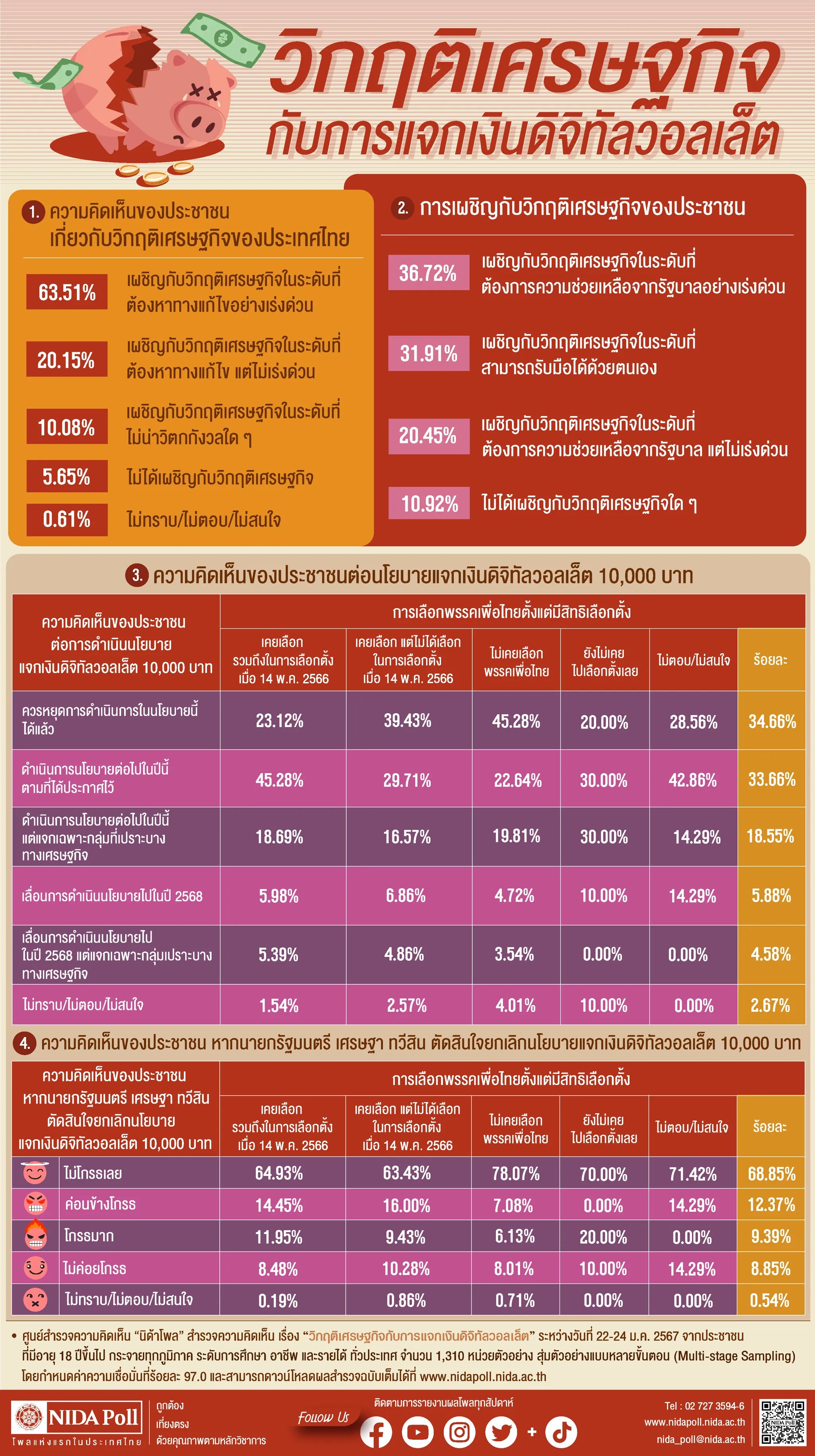
According to the survey findings, when the informants were asked about their opinion on Thailand's current economic crisis, 63.51% indicated that the crisis required urgent attention, while 20.15% felt that the crisis needed attention but not urgently. Additionally, 10.08% did not consider the crisis a serious concern, 5.65% stated that they did not experience any economic crisis, and 0.61% either did not know, did not respond, or were not interested.
In terms of public experiences with the current economic crisis, the survey revealed that 36.72% expressed a need for urgent government assistance, while 31.91% believed they could handle the economic crisis independently. Moreover, 20.45% indicated a requirement for government assistance, though not urgently, and 10.92% reported they did not encounter any economic crisis.
In relation to public opinion on the distribution of 10,000 Baht through the Digital Wallet, findings indicated that 34.66% believed the policy should be cancelled, while, 33.66% felt the policy should continue as initially planned for this current year. Furthermore, 18.55% expressed support for continuing the policy but with a focus on economically vulnerable groups. 5.88% agreed that the policy should be postponed until 2025, and 4.58% added that the postponement should also prioritize economically vulnerable groups. Finally, 2.67% either did not express an opinion, did not respond to the survey, or were not interested.
Regarding potential emotional reactions if the Prime Minister, Srettha Thavisin, cancels the Digital Wallet policy, findings showed that 68.85% indicated they would not be angry at all, while 12.37% expressed some degree of anger. 9.39% stated they would be very angry, and 8.85% mentioned they would not be very angry. Finally, 0.54% either did not have a clear emotional response, did not answer the survey, or were not interested.
Upon analyzing the general characteristics of the sample, the following observations were made: (i) 8.55% of the participants reside in Bangkok areas. (ii) 18.55% reside in the Central region. (iii) 1 8.01% reside in the Northern region. (iv) 33.44% reside in the Northeastern region. (v) 13.74% reside in the Southern region. (vi) 7.71% reside in the Eastern region. In terms of gender distribution, 48.09% of the participants are male, while 51.91% are female.
Regarding age, the participants fell within the following brackets: (i) 12.90% are aged 18-25 years old. (ii) 17.79% are aged 26-35 years old. (iii) 18.93% are aged 36-45 years old. (iv) 26.64% are aged 46-59 years old. (v) 23.74% are aged 60 years old or older.
Regarding religious beliefs, 95.95% of the participants identify themselves as Buddhists, 3.59% identify as Muslims, and 0.46% identify as Christians and others. In terms of marital status, 36.18% of the participants are single, 61.83% are married, and 1.99% are widows, divorced, and separation.
Regarding educational attainment: (i) 24.50% have completed elementary school or lower. (ii) 36.18% have completed secondary school or equivalent. (iii) 9.31% have completed diploma or equivalent. (iv) 25.73% have completed a bachelor's degree or equivalent. (v) 4.28% have attained education postgraduate or equivalent.
The survey also considered participants' professions: (i) 8 47 work as government officials/employees/state enterprise employees. (ii) 1 7.02 work in the private enterprise employees. (iii) 21. 76 are business owners/freelancers. (iv) 1 1 99 are agriculturists/fisheries. (v) 15 .11 are general hires/worker. (vi) 19. 85 are husbands/housewives/retired/unemployed. (vii) 5.80 are students/university students. Lastly, in terms of income distribution: (i) 23.36% do not have any income. (ii) 19.24% not exceeding of 10,000 Baht. (iii) 29.31% have an average monthly income between 10,001 to 20,000 Baht. (iv) 9.39% have an average monthly income between 20,001 and 30,000 Baht. (v) 3.13% have an average monthly income between 30,001 and 40,000 Baht. (vi) 4. 43% more than 40,001 or higher. (vii) 11.14% did not specify their income.