
Thais Back Military Use of Drones, Citing Security and Cost Benefits
A majority of Thais support the use of drones in national defense operations, seeing the technology as a way to strengthen security while reducing risks to troops. Supporters point to drones’ role in surveillance and reconnaissance and say their deployment could help cut long-term defense costs, improving efficiency without increasing personnel losses.
We are pleased to present the results of the “Drons for Military and National Security Missions” conducted by NIDA Poll, the public opinion research center of the National Institute of Development Administration (NIDA). The survey was conducted during 5 – 7 November 2025 among Thai citizens aged 18 years and over who had completed at least secondary education or its equivalent. The respondents were distributed across all regions, occupations, and income levels nationwide, comprising a total of 1,310 samples. The survey aimed to explore public opinions toward the use of drones in Thailand’s military and national-security missions. The sampling was conducted using a probability sampling method based on the Master Sample Database of NIDA Poll through a multi-stage sampling technique. Data were collected via telephone interviews, with a margin of error not exceeding ±0.05 at a 97.0% confidence level.
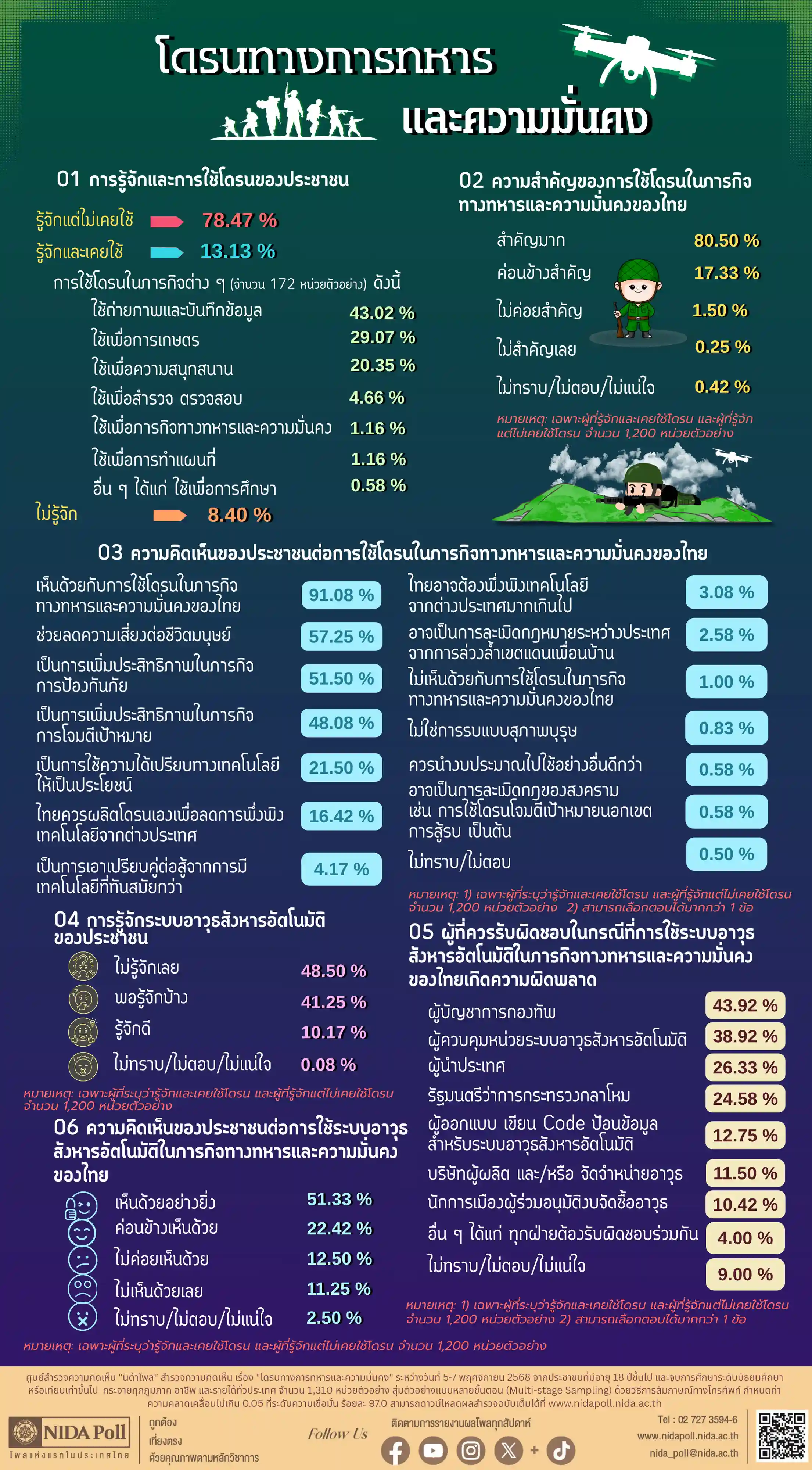
According to the survey, when respondents were asked about their familiarity and use of drones, 78.47% indicated that they have heard about drones but have never used one, while 13.13% reported that they heard and had used drones, and 8.40% said they did not know about drones
Among those who stated that they heard and had used drones (a total of 172 respondents), 43.02% reported using drones for photography and data recording, followed by 29.07% for agricultural purposes, 20.35% for recreational use, 4.66% for surveying and inspection, and 1.16% each for military and security missions and mapping purposes. In addition, 0.58% cited other purposes, such as education.
When asking only those who reported being familiar with drones, whether they had used them or not (a total of 1,200 samples) on the following issues:
When focusing on respondents who were asked about the importance of drone using in Thailand’s military and national security missions, the results revealed that 80.50% considered it very important, 17.33% said slightly important, 1.50% stated slightly unimportant, 0.42% responded don’t know / no answer / unsure, and 0.25% considered it not important at all.
When asked about their opinions regarding the use of drones in Thailand’s military and national security missions, 91.08% of respondents agreed with such use. Additionally, 57.25% stated that drones help reducing risks to human lives, 51.50% believed drones enhance defense efficiency, 48.08% said drones improve striking missions, 21.50% saw them as leveraging technological advantages, and 16.42% believed Thailand should develop its own drones to reduce dependency on foreign technology. Meanwhile, 4.17% viewed drones as providing an unfair advantage over opponents, 3.08% expressed concern about overreliance on foreign technology, 2.58% noted that their use may violate international law through border incursions, Additionally, 1.00% disagreed with the military use of drones, 0.83% stated that it was not a gentleman’s war, and 0.58% suggested that the budget should be spent on other priorities or that such actions may violate the rules of war, for example by attacking outside designated combat zones. Finally, 0.50% responded don’t know / did not respond.
When asked about familiarity of Lethal Autonomous Weapon Systems (LAWS), 48.50% of respondents reported being not familiar at all, 41.25% said they were somewhat familiar, 10.17% said they were well familiar, and 0.08% responded don’t know / did not respond / were unsure.
Regarding responsibility in the event of a malfunction or error involving Lethal Autonomous Weapon Systems in Thailand’s military and national security missions, 43.92% believed that the Commander-in-Chief should be held responsible, followed by 38.92% who cited the system operator, 26.33% who pointed to the national leader, 24.58% who mentioned the Minister of Defense, 12.75% who named the system designers or coders, 11.50% who cited the manufacturing or distributing company, and 10.42% who identified politicians who approved the procurement budget. In addition, 9.00% said responded don’t know / did not respond / were unsure, and 4.00% mentioned other views, such as that all parties involved should share joint responsibility.
Finally, when asked about their opinion on the use of Lethal Autonomous Weapon Systems in Thailand’s military and national security missions, 51.33% said they strongly agreed, 22.42% somewhat agreed, 12.50% somewhat disagreed, 11.50% strongly disagreed, and 2.50% responded don’t know / did not respond / were unsure.
General Characteristics of the Sample
Upon considering the general characteristics of the sample, it was found that 8.55% of the respondents had their domicile in Bangkok, 18.70% in the Central region, 17.79% in the Northern region, 33.28% in the Northeastern region, 13.82% in the Southern region, and 7.86% in the Eastern region. Of the total sample, 47.94% were male and 52.06% were female.
In terms of age, 12.13% of the respondents were 18–25 years old, 17.79% were 26–35 years old, 17.94% were 36–45 years old, 26.34% were 46–59 years old, and 25.80% were 60 years and over. Regarding religion, 95.73% were Buddhists, 2.98% were Muslims, and 1.29% were Christians and other religions.
Considering marital status, 37.10% of the respondents were single, 60.99% were married, and 1.91% were widowed, divorced, or separated. In terms of education level, 29.85% had completed secondary school or equivalent, 12.75% held a diploma or equivalent, 48.01% held a bachelor’s degree or equivalent, and 9.39% had education higher than a bachelor’s degree.
As for occupation, 15.88% were government officials, employees, and state enterprise employees, 20.69% were private enterprise employees, 23.74% were business owners or self-employed, 6.72% were farmers or fishers, 9.99% were general workers or laborers, 19.01% were homemakers, retirees, or unemployed, and 3.97% were students or university students.
Lastly, regarding monthly income, 13.44% had no income, 0.61% earned not more than 5,000 baht, 9.69% earned 5,001–10,000 baht, 34.97% earned 10,001–20,000 baht, 15.11% earned 20,001–30,000 baht, 8.78% earned 30,001–40,000 baht, 4.35% earned 40,001–50,000 baht, 2.82% earned 50,001–60,000 baht, 0.92% earned 60,001–70,000 baht, 0.15% earned 70,001–80,000 baht, 1.60% earned 80,001 baht or more, and 7.56% did not specify their income.